CM Punjab Free Livestock Program for Widowed Women – Financial Aid & Empowerment
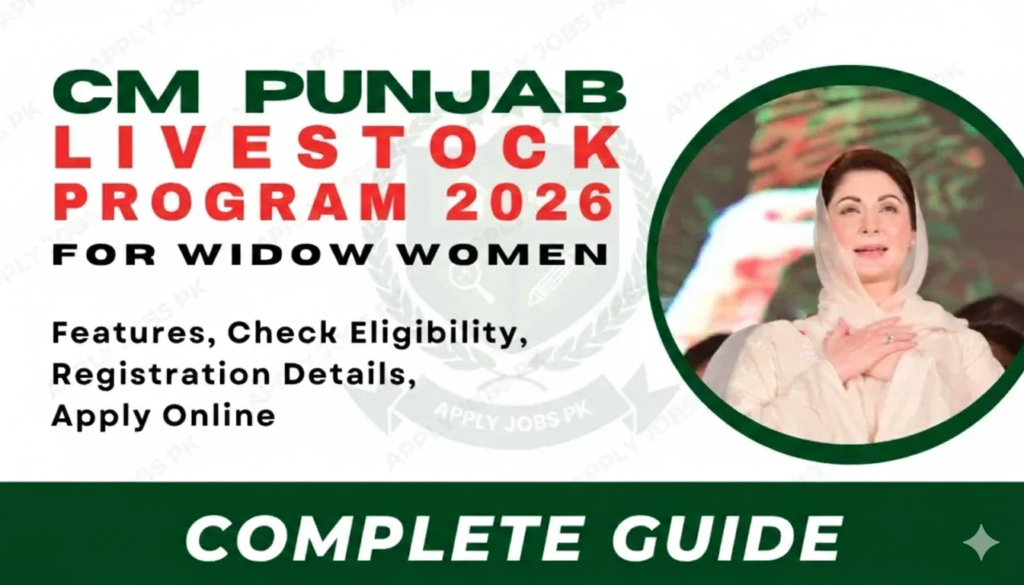
The Punjab government has rolled out the CM Punjab Free Livestock Initiative 2025. This is one of its firsts and is aimed at giving widowed and poor women the strength and independence that they need. In this particular initiative, women will be given high-quality livestock such as cows, buffalo, goats, and even poultry. Additionally, they will receive appropriate training. This will help them generate incomes and also improve the health standards that they currently maintain.
Purpose & Key Objectives of the Program
The CM Punjab Free Livestock Program is built on several guiding objectives:
- It is aimed at giving widowed and less fortunate women a chance to earn incomes, rather than depending on charity or aid.
- To foster small-scale livestock keeping as an economically viable livelihood option for rural women, especially in cases where agricultural alternatives are limited.
- To improve the families’ food security by allowing dairy, poultry, or meat production at household level.
- Increasing participation by rural women in economic, agricultural, and business activities with a view to enlarging their role in the local economy. in economic, agricultural and business activities, thereby enlarging their role in the local economy.
By focusing on asset-transfer (livestock) rather than just cash grants, the program seeks long-term benefits rather than short-term relief.
“Program Highlights: Key Features & Advantages
The CM Punjab Free Livestock Program provides beneficiaries with a comprehensive support package, including:”
- Free distribution of farm animals (such as a cow or a buffalo for milk production, or goats and/or poultry for farming).
- Complete veterinary services for vaccinations, checkups, and animal health support to keep the asset productive.
- Training of beneficiaries on animal rearing, animal feeds, animal health, marketing of products (milk, meat, and egg) and bookkeeping.
- Monitoring by the relevant officials of the livestock department for the effective use of these assets.
- Real income-generating potential: Beneficiaries can sell milk, eggs, and/or meat in local markets, hence creating a potential for income generation in their own right.
The holistic nature of the program – asset + training + health + monitoring – sets the CM Punjab Free Livestock Program apart from simpler welfare schemes.
“Who Can Apply: Requirements for Widowed Women
Applicants must fulfill certain conditions to qualify for the CM Punjab Free Livestock Program 2025:”
- The applicant should be a woman and hopefully widowed (or divorced and abandoned in some situations).
- She should be a permanent resident of the Punjab state, especially within the chosen underveloped districts.
- The family must have been classified as low income (poverty/proxy means test applies) and the woman must not hold or have previously held a government job or received a similar grant for livestock.
- Women living in areas where cattle rearing is practiced are those that get the most preference.
- Certain versions of the plan include the setting of an age criterion (for example, less than 55), a specific poverty score criterion (PMT <32), and residency within one of the nominated districts.
“These criteria are designed to ensure that the program’s support reaches the women who need it most and the regions where it can create the maximum impact.”
“Application Guide: Step-by-Step Registration
The CM Punjab Free Livestock Program 2025 offers a simple application process, accessible through both online and offline methods:”
- The applicants download either the mobile application specifically made (“Asset Transfer to Rural Women”) or access the government-run Punjab Livestock Department website and submit an online application.
- Required documents: valid CNIC, widowhood or divorce documents, domicile residency, documents related to being impoverished or income, and other documents as may be required.
- For offline registration, it can be done through regional animal/veterinarian offices in rural settings where internet access may not be available in some cases.
- The applications are then checked through inspection, database verification (like NADRA), or a computerized random selection in which eligible women are selected.
- The pre-identified beneficiaries are issued with SMS notification and directed on where to go for animal collection.
“For instance, Phase 2 of the program accepted applications from June 1 to August 31, targeting eligible participants across 12 districts in South Punjab.”
Distribution & Support Details of the Free Livestock Program
The CM Punjab Free Livestock Program 2025 phases comprise:
- Phase 1: Initial rollout distributing several thousand animals to rural women to pilot the scheme and gather feedback.
- Phase 2: Expansion across 12 districts (Multan, Khanewal, Lodhran, Vehari, Bahawalpur, Bahawalnagar, Rahim Yar Khan, Dera Ghazi Khan, Layyah, Muzaffargarh, Rajanpur, Kot Addu) with target of 6,000-7,000 high-yield animals donated.
- Budget: The provincial government allocated approximately PKR 2 billion (and in some announcements PKR 2.5 billion) for the program covering animal procurement, feed, training and veterinary services.
- The selected animals are high‐yield breeds, disease‐resistant, and fit for the local climate so the beneficiaries have a strong chance of sustained success.
This component of the scheme—asset transfer plus follow-through—makes the CM Punjab Free Livestock Program a strategic welfare intervention rather than a one-off giveaway.
Economic & Social Benefits for Women and Communities
The CM Punjab Free Livestock Program brings multiple economic and social benefits:
- Reliable source of income: Through owning a productive animal, a widow is able to make sales from milk, meat, and eggs thus getting a steady source of income rather than depending on income from labor.
- Improved nutrition: With cows or chickens, families can now enjoy milk, egg, or protein from chicken, improving the nutrition of children and women.
- Empowerment & dignity: When a productive asset is provided, it enhances independence and dignity. Women shift from being passive recipients to active producers.
- Rural development: With increased households practicing livestock production, rural markets develop, and suppliers of livestock feed and veterinary services also develop, resulting in rural economies developing.
- Poverty reduction: Support of widows in poverty-stricken families can help reduce vulnerability and make sure that those who are left out of the idea of targeting are supported.
Overall, the initiative turns welfare support into long-term income opportunities under the CM Punjab Free Livestock Program.
Training, Monitoring & Sustainable Outcomes
Successful asset transfer alone isn’t enough — the CM Punjab Free Livestock Program takes the next step:
- The recipients are provided with workshops in feeding, handling diseases, keeping records, marketing agricultural products, and planning finances.
- Animal care services and mobile animal care units are employed in the rural areas to aid in vaccinations, de-worming, and early disease treatment.
- Monitoring frameworks are important because they make sure that animals are being productive and that training inputs are being used by beneficiaries while results are also being assessed to improve learning by the government.
- “The goal is expected to have sustainable results over time because the assisted resource, which is livestock, will be of great value to the family as an intergenerational resource, as it will produce offspring and give money through selling milk. Additionally, the family will not need to rely
This strategic design secures the future of the CM Punjab Free Livestock Program’s positive impact.
Program Overview at a Glance
- Program: CM Punjab Free Livestock Program 2025
- Beneficiaries: Widowed or low-income women in Rural Punjab (primarily South Punjab)
- Support Provided: One livestock (cow, buffalo, goat or poultry) animal, as well as veterinary support, training, and monitoring
- Coverage Area: Starting in 12 highly impoverished districts of South Punjab
- Budget: Approximately PKR 2 billion – 2.5 billion for phases encompassing 11,000 women in Phase I
- Methods of applying: Online portal, mobile app, and offline method through animal offices/veterinary hospitals
- “Sustain” – to support or continue something
Conclusion
The CM Punjab Free Livestock Program 2025 is yet another profoundly new way of doing things by the government of Punjab in assisting widow and financially challenged women in their province. Because this project offers livestock and training coupled with veterinary services and regular monitoring, it not only provides solace but also offers opportunity, dignity, and sustainable change..
For eligible women living in rural Punjab who meet the criteria, now is the time to apply: this scheme offers a real chance to build a stable income, improve household nutrition and take charge of their future. With careful implementation, the CM Punjab Free Livestock Program could reshape rural livelihoods, strengthen women’s economic role and deepen the impact of welfare support into true empowerment.